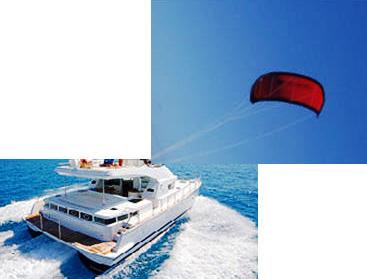
Imagine a mono-hull ship or catamaran with one or more very large kite(s) pulling you across the Atlantic Ocean in approx. 5 to 10 days! That's what this idea is about!
You're asking what happens if there's no wind during the journey? Don't worry, the yacht will carry rechargeable batteries powerful enough to take you further - batteries that will be charged by 'clean' energy.
The overall concept is simple: The wind captured by the kites is the main power source. But the vessel will also be equipped with regular propellers. These will push the ship forward if there's not enough wind for the kites. At high winds, when the kites pull the yacht, the propellers will serve as generators charging the batteries. If there's no wind at all for a longer period of time, the batteries will be charged by solar cells - ensuring at least low speed any time.
But how can you expect to cross the Atlantic Ocean in only 5 days? Even fast sailing boats or ships like the Queen Mary need more time, you might say.
Well, the reason is that your Zero Emissions Yacht (let's use this term and the acronym Z.E.Y. here) will cruise 'on top of the water', a way of movement called planing. To achieve this, the speed must be high enough so that the hydrodynamic drag of the vessel will be significantly reduced. This happens during the kites powered phases of the voyage at strong winds. At gentle breezes, however, the propellers (connected to electric engines / rechargeable batteries) will only push the ship through the water at low speed. Thus the kites must be large enough to ensure that planing is achieved during major part of the voyage.
For a calculation to check feasibility, I derived data from 2 types of yachts, a 75 ft. mono-hull and a 43 ft. catamaran, and calculated what it would mean to power vessels of that kind
Summary of the calculation is that for the 2 boat sizes selected, today’s kites are not large enough. However, as technology evolves, it should be possible in the (near?) future. The concept should work already today at a smaller scale - for boats with up to 3 metric tons total mass (approx. length 8 to 9 meters or 24 to 30 feet), prototypes could be built using currently available technology.
Check the calculation - to agree (or disagree) that such a concept is feasible in the (near) future!
Any feedback is highly appreciated!
Dipl.-Ing. Hans-Peter Thamm (Germany)
M a i l : info [AT] <this_URL_including .com>
F a x : +49-3221-1276177